 +91 85238 33348
 kumarpre@hotmail.com
A patient-friendly guide to understanding when repeat coronary artery calcium scoring may be useful
By Dr. R. K. Jain
Founder Director & Head of Department of Cardiology
KIMS Hospital, Secunderabad
Why this question matters
A Coronary Artery Calcium scan, commonly called a CAC scan or calcium score test, is a CT-based test that helps detect calcium deposits in the coronary arteries. These calcium deposits are a sign of plaque build-up in the heart arteries and can help estimate future heart risk.
One of the most common questions patients ask after their first calcium score is: “Should I repeat the CAC scan again?”
The answer is simple but important: not every patient needs a repeat CAC scan. The decision depends on the baseline calcium score, overall heart-risk profile, symptoms, and whether the result will actually change treatment decisions.
What is a CAC scan?
A CAC scan measures the amount of calcified plaque present in the coronary arteries. It is mainly used as a preventive risk-assessment tool. It can help doctors decide how aggressively a patient may need cholesterol control, lifestyle changes, blood pressure management, diabetes control, and other preventive strategies.
A CAC scan is not the same as an angiogram. It does not directly show the percentage of blockage and it does not replace urgent evaluation when symptoms are present.
A practical guide to repeat CAC scanning
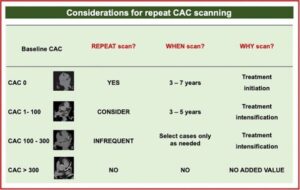
The need for repeat scanning usually depends on the first CAC score. The guide below can help patients understand the broad approach, but the final decision should always be personalized by a cardiologist.
Quick interpretation
| Baseline CAC score | Repeat scan? | Usual timing | Main purpose |
| CAC 0 | Yes, in selected patients | 3-7 years | Treatment initiation if risk changes |
| CAC 1-100 | Consider | 3-5 years | Treatment intensification if needed |
| CAC 100-300 | Infrequent | Selected cases only | Treatment adjustment in special situations |
| CAC > 300 | Usually no | Usually no repeat needed | Focus on intensive prevention |
When can a repeat CAC scan be useful?
Repeat CAC scanning is most useful when the new result can change the treatment plan. It should not be done just for curiosity or as a routine yearly test.
- When the first CAC score is 0
A calcium score of 0 is generally reassuring, but it does not mean lifetime protection. Some people may develop coronary calcium later, especially if they have diabetes, smoking history, high LDL cholesterol, high blood pressure, obesity, or a strong family history of heart disease.
In selected patients, a repeat scan may be considered after a few years if the result will help decide whether preventive treatment should be started or intensified.
- When the first CAC score is 1-100
A score between 1 and 100 suggests mild calcium build-up. A repeat scan may be considered after a few years in selected patients, especially when the doctor wants to reassess progression and refine preventive treatment.
- When the first CAC score is 100-300
A score in this range already confirms the presence of coronary atherosclerosis. In many patients, the priority is not repeat scanning but stronger risk-factor control. Repeat scanning may be reserved for special situations where the result will clearly influence management.
- When the first CAC score is above 300
A high CAC score usually means the patient is already in a higher-risk category. Repeating the same scan often adds little value. The focus should be on strict prevention, regular follow-up, and treatment optimization.
| Key message for patients:
The goal is not to keep repeating scans. The goal is to reduce future heart risk through the right prevention plan. |
What matters more than repeating the scan?
A CAC result is useful only when it leads to better action. After a calcium score test, patients should focus on controlling the risk factors that drive plaque progression.
- Maintain healthy LDL cholesterol levels as advised by your cardiologist.
- Control blood pressure consistently.
- Keep diabetes and blood sugar under control.
- Stop smoking completely and avoid tobacco in all forms.
- Exercise regularly after medical clearance.
- Follow a heart-healthy diet and maintain a healthy weight.
- Take prescribed medicines regularly and do not stop them without medical advice.
When should you not wait for a repeat CAC scan?
A CAC scan is not the right test when a patient has active symptoms. If you have chest pain, breathlessness on exertion, heaviness in the chest, pain spreading to the arm or jaw, sweating, dizziness, or sudden worsening fatigue, you should seek medical evaluation immediately.
In symptomatic patients, the doctor may advise ECG, blood tests, echocardiography, stress testing, CT coronary angiography, or coronary angiography depending on the clinical situation.
Final message from Dr. R. K. Jain
Not every patient needs a repeat CAC scan. For some patients with low or zero calcium score, repeating the scan after a few years can help guide preventive decisions. For patients with higher scores, the better approach is often aggressive prevention and regular cardiology follow-up.
The decision should be personalized. Your baseline calcium score, age, cholesterol levels, diabetes status, blood pressure, smoking history, family history, symptoms, and current treatment plan all matter.
| Patient action:
If you have already had a CAC scan, discuss your report with a cardiologist before deciding whether another scan is needed. |
Doctor Information

Disclaimer
This article is for awareness and education only. It should not be used as a substitute for medical consultation, diagnosis, or treatment. Please consult your cardiologist for personalized advice.