 +91 85238 33348
 kumarpre@hotmail.com
Do I Need a Pacemaker? Signs, Procedure and Life With a Pacemaker
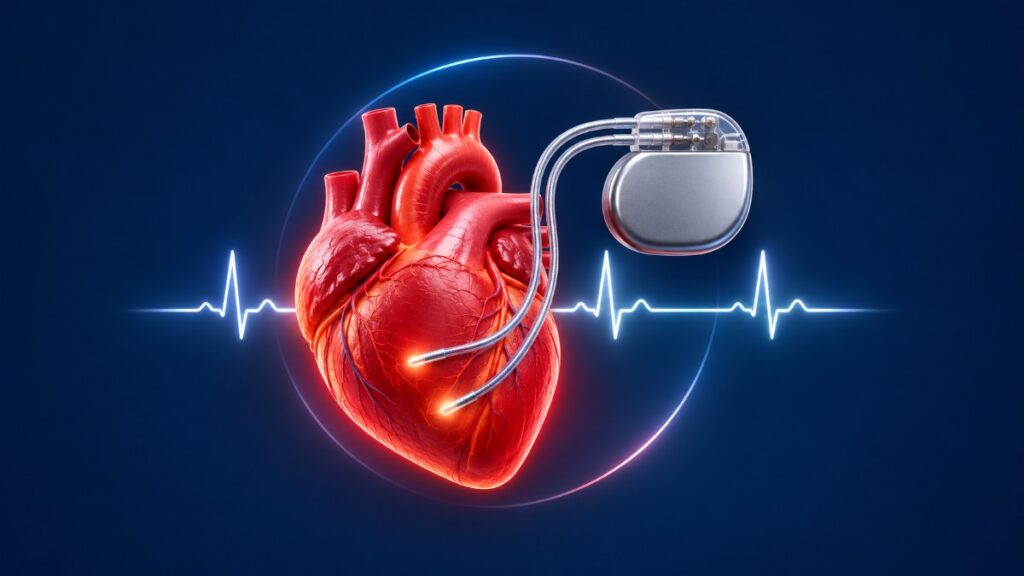
Feeling dizzy, unusually tired or fainting without warning can sometimes mean the heart is beating too slowly. When the heart’s own electrical system fails, a pacemaker can restore a safe heart rate and give people back a normal, active life. Here is a clear guide to who needs one and what to expect.
- A pacemaker is a small device placed under the skin below the collarbone that keeps the heart from beating too slowly.
- Common reasons are heart block and sick sinus syndrome, which cause dizziness, fainting, tiredness or breathlessness.
- The procedure is done under local anaesthesia, usually takes about an hour, and most people go home within 1 to 2 days.
- Most daily activities, including mobile phones and household appliances, are safe with sensible precautions.
What is a pacemaker?
The heart has a natural pacemaker called the sinus node, which sends an electrical signal with every beat. This signal travels through a conduction pathway to the lower chambers. If the signal is too slow or gets blocked, the heart rate drops. An artificial pacemaker monitors your heartbeat continuously and sends a tiny, painless electrical pulse only when the heart needs it.
Who needs a pacemaker?
- Sick sinus syndrome: the natural pacemaker fires too slowly or pauses.
- Heart block: signals from the upper chambers do not reach the lower chambers properly.
- Slow heart rate with atrial fibrillation.
- After certain heart procedures, such as valve replacement (including TAVI), when the conduction system is affected.
- Selected patients with heart failure may benefit from a special biventricular pacemaker (CRT) that coordinates the heart’s pumping.
Symptoms that should not be ignored
- Dizziness or light-headedness
- Fainting or near-fainting, especially without warning
- Unusual tiredness and reduced ability to exercise
- Breathlessness or swelling of the feet
- Confusion or poor concentration in older adults
- A pulse that is persistently below 50 beats per minute along with any of the above
How the diagnosis is made
An ECG is the first test. Because slow rhythms may come and go, a 24 to 48 hour Holter monitor or a longer event monitor may be needed. An echocardiogram checks heart muscle and valves, and blood tests rule out reversible causes such as thyroid problems, electrolyte imbalance or medicines that slow the heart.
Types of pacemakers
| Type | How it works | Typically used for |
|---|---|---|
| Single-chamber | One lead, usually in the right ventricle | Slow rhythm with permanent atrial fibrillation |
| Dual-chamber | Two leads, in the right atrium and right ventricle | Heart block and sick sinus syndrome; keeps the upper and lower chambers in step |
| Leadless | A capsule-sized device placed directly inside the heart through a vein in the leg | Selected patients, for example those at higher risk of lead or pocket problems |
| Biventricular (CRT) | Three leads that coordinate both ventricles | Selected heart failure patients with a weak, poorly coordinated heart |
A pacemaker is different from an ICD, a device that can also deliver a shock to stop dangerous fast rhythms. Your cardiologist will advise which device suits you.
What happens during the procedure
- The area below the collarbone is numbed with local anaesthesia. You stay awake but comfortable, with mild sedation if needed.
- One or more thin leads are guided through a vein into the heart using X-ray imaging.
- The leads are tested and connected to the pacemaker, which is placed in a small pocket under the skin.
- The wound is closed, usually with dissolvable stitches. The whole procedure typically takes about an hour.
Recovery: the first six weeks
- Keep the wound clean and dry as advised and watch for redness, swelling or discharge.
- Avoid lifting the arm on the device side above shoulder level and avoid heavy lifting for about 4 to 6 weeks, so the leads settle firmly.
- Gentle daily walking is encouraged from the start.
- Most people return to desk work within one to two weeks. Your cardiologist will advise when you can drive.
Living with a pacemaker
| Situation | What to do |
|---|---|
| Mobile phones | Safe to use. Hold the phone to the ear on the opposite side and do not keep it in a shirt pocket over the device. |
| Household appliances | TV, microwave, mixer and computers are safe. Keep induction cooktops and strong magnets a short distance from the device. |
| Airport security | Show your pacemaker ID card. Ask for a hand check instead of lingering in the walk-through scanner. |
| MRI scans | Possible only with MRI-conditional systems and with the device programmed before and after. Always inform the team. |
| Exercise and travel | Walking, yoga, cycling and travel are encouraged. Avoid contact sports that could hit the device. |
Follow-up and remote monitoring
Regular device checks, usually every 6 to 12 months, confirm that the battery and leads work well and allow settings to be fine-tuned. Many modern pacemakers can also be checked remotely from home.
The bottom line
Unexplained dizziness, fainting or extreme tiredness with a slow pulse deserves a heart rhythm evaluation. For the right patient, a pacemaker is a safe, well-established treatment that relieves symptoms and restores an active life.
Frequently asked questions
Is a pacemaker implantation major surgery?
No. It is a minor procedure done under local anaesthesia through a small cut below the collarbone, without opening the chest.
Will the pacemaker give me shocks?
No. A pacemaker sends tiny pulses you will not feel. Shocks are delivered only by a different device called an ICD.
Can I lead a normal life with a pacemaker?
Yes. Most people return to work, travel, exercise and normal family life, often feeling much better than before.
Is there an age limit?
No. Pacemakers are fitted safely in young adults as well as people in their 80s and 90s when they are needed.
What happens when the battery runs out?
The device warns well in advance during routine checks. The generator is replaced in a short procedure, usually through the same scar.

This article is for general patient education and is not a substitute for a consultation. Treatment decisions depend on your individual reports, anatomy and overall health, and should be made with your cardiologist.