 +91 85238 33348
 kumarpre@hotmail.com
Does Every Complex Angioplasty Need IVUS? What New 2026 Studies Really Show
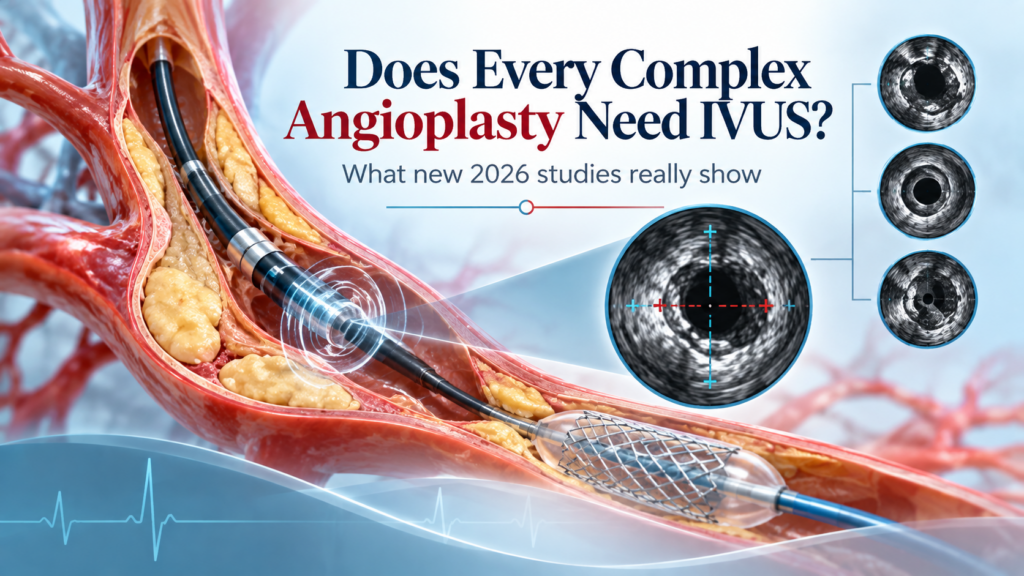
“IVUS-guided angioplasty gives better results.” You may have read this, and there is good evidence behind it. But in 2026, two major trials presented at the same cardiology meeting reached very different verdicts. Understanding why tells you a lot about what really makes an angioplasty successful.
First, what is IVUS?
Intravascular ultrasound is a miniature ultrasound probe on a catheter. It is passed inside the heart artery to show the plaque and the stent from within, in far more detail than a standard angiogram.
What counts as a “complex” angioplasty?
Cardiologists use the term for procedures where the anatomy or the patient’s condition makes stenting more demanding. Common examples:
- Blockages in the left main artery
- Bifurcation blockages, where an artery divides into two branches
- Long blockages needing long or multiple stents
- Heavily calcified arteries
- Chronic total occlusions, where an artery has been completely blocked for months
- Disease in several arteries at once
- A previous stent that has narrowed again
These are grouped together as “complex”, but they are quite different problems. That matters when reading the trial results.
What an angiogram can miss
An angiogram is an X-ray outline of the blood channel. It cannot show the artery wall, the amount of plaque behind it or the exact fit of a stent. A stent that looks fine on X-ray may be slightly under-expanded or not fully against the wall. IVUS shows this directly, so it can be corrected before the procedure ends.
Two trials, two verdicts
| IVUS-CHIP | DKCRUSH VIII | |
|---|---|---|
| Who was studied | 2,020 patients with a broad mix of complex blockages (long, calcified, bifurcation, total occlusions) | 555 patients with complex bifurcation blockages, nearly all treated with one specific two-stent technique (DK crush) |
| Where | 37 centres in Europe | 24 centres in China |
| Treated-vessel failure, IVUS vs angiography alone | 13.9% vs 11.1% (at about 19 months) | 6.0% vs 14.7% (at one year) |
| Verdict | No overall advantage for IVUS | Clear advantage for IVUS |
A closer look at IVUS-CHIP
This European trial took a deliberately broad approach. Any patient having a complex or high-risk angioplasty could be included. About six in ten had long blockages, over four in ten had severe calcification, a third had true bifurcation disease and about one in five had a chronic total occlusion.
After a median of 19 months, the combined rate of cardiac death, heart attack in the treated artery or repeat procedure was not lower with IVUS. The difference between the groups could have been due to chance.
One finding did favour IVUS: definite or probable stent clotting was less frequent (0.5% compared with 1.5%). Stent clotting is uncommon but serious, so this is worth noting, although a secondary finding like this is less certain than a trial’s main result.
A closer look at DKCRUSH VIII
This trial asked a narrower question. Every patient had a complex bifurcation blockage, and in over four in ten the left main artery was involved. Almost all were treated with the DK crush technique.
Here IVUS made a large difference: 6.0% of patients had a failure of the treated vessel at one year, compared with 14.7% with angiography alone. The benefit came mainly from fewer heart attacks and fewer repeat procedures, and was seen across the patient subgroups examined.
What “acting on the images” means
In practice the operator checks specific targets on IVUS before finishing:
- Is the stent expanded to an adequate size for that artery?
- Is it in full contact with the wall?
- Are both branches of a bifurcation well opened?
- Is there any tear at the edges of the stent?
If a target is not met, the operator does more work, such as further balloon inflation. The value of IVUS comes from those corrections.
Does this mean results depend on where you are treated?
It means experience counts. Trials from centres where intravascular imaging is used routinely have more often shown a benefit. IVUS is a tool for an operator who uses it regularly, knows what a good result looks like and is prepared to do the extra steps it calls for.
What about OCT?
OCT is the light-based alternative to IVUS. In a separate 2026 trial of left main bifurcation stenting, OCT guidance performed as well as IVUS guidance. For many complex cases the more important point is that some form of imaging is used well.
Myth vs fact
Fact: In a broad group of complex cases, IVUS-CHIP did not show fewer overall failures with IVUS. The difference between the groups was not statistically significant.
Fact: In DKCRUSH VIII, failures were less than half as frequent with IVUS, mainly through fewer heart attacks and repeat procedures. Even in IVUS-CHIP, stent clotting was rarer with IVUS (0.5% compared with 1.5%).
Fact: They asked different questions in different patients.
Why the results differ
- The type of blockage. “Complex” covers a lot. A long blockage is not the same challenge as a fork in a major artery needing two stents. The benefit of imaging appears greatest where precision matters most.
- How the images are used. In DKCRUSH VIII, operators worked towards defined targets on the IVUS images. Simply taking pictures is not the same as acting on them.
- Experience. Researchers have noted that imaging trials from centres with long, routine experience of intravascular imaging have tended to show more benefit.
Knowing when and how to use it matters even more.
When imaging is most likely to help
- Blockages at a bifurcation, especially when two stents are planned
- Left main artery disease
- Heavily calcified arteries
- A previous stent that has narrowed or clotted
- When the angiogram alone leaves the picture unclear
Your cardiologist decides this case by case.
Questions worth asking before a complex angioplasty
- Is my blockage considered complex, and why?
- Will IVUS or OCT be used during my procedure?
- If so, what will you be checking with it?
- How often do you perform this type of procedure?
The bottom line
Not every complex angioplasty has been proven to need IVUS. In the right blockage, used by an experienced operator who acts on what it shows, it can make a real difference. Be cautious of anyone who says a single technology is always the answer.
Frequently asked questions
What is IVUS-guided angioplasty?
It is an angioplasty in which a tiny ultrasound probe is passed inside the heart artery to measure it and to check the stent after it is placed, in addition to the usual X-ray angiogram.
Is IVUS-guided angioplasty always better than a standard angioplasty?
No. In 2026 a large trial across many types of complex blockage did not show an overall advantage, while a trial focused on complex bifurcation stenting showed a clear benefit. The benefit depends on the type of blockage and how the imaging is used.
In which cases is IVUS most useful?
Left main disease, bifurcation blockages needing two stents, heavily calcified arteries, failed previous stents and situations where the angiogram is unclear.
Does IVUS add risk to the procedure?
Complications from the IVUS catheter are uncommon. It adds a few minutes and does not need extra contrast dye to take images.
Does IVUS increase the cost of angioplasty?
The imaging catheter is an additional item, so it does add to the cost. Ask your hospital for an estimate, and ask your cardiologist whether it is expected to add value in your particular case.
Will I feel the IVUS catheter?
No. It moves over the same wire as the balloon and stent and is not felt inside the artery.
If my angioplasty was done without IVUS, should I be worried?
No. Most angioplasties, including many complex ones, give good results with angiography alone. If you have concerns or new symptoms, discuss them with your cardiologist.

This article is for general patient education and is not a substitute for a consultation. Treatment decisions depend on your individual reports, anatomy and overall health, and should be made with your cardiologist.